Try Better Bookshelf free — catalog your first 50 books, no sign-up.


Guide
Home library ideas: how to organize a book collection you can actually find things in
Every big book collection reaches the same moment: you know you own it, you just can't find it. Shelves fill, stacks form on the floor, and the pleasure of owning books starts to feel like managing inventory — badly, from memory.
The difference between a pile of books and a home library isn't the shelving — it's the system. This guide covers the organizing systems that actually work at scale, the shelving and storage ideas to match, and the step almost everyone skips that makes all of it stick.
Step 0: you can't organize what you haven't counted
Rearranging shelves before you know what you own is how home library projects fail — halfway through, you discover a genre you forgot, three duplicate copies, and no room in the plan for any of it. Professional librarians never start with the shelves. They start with the catalog.
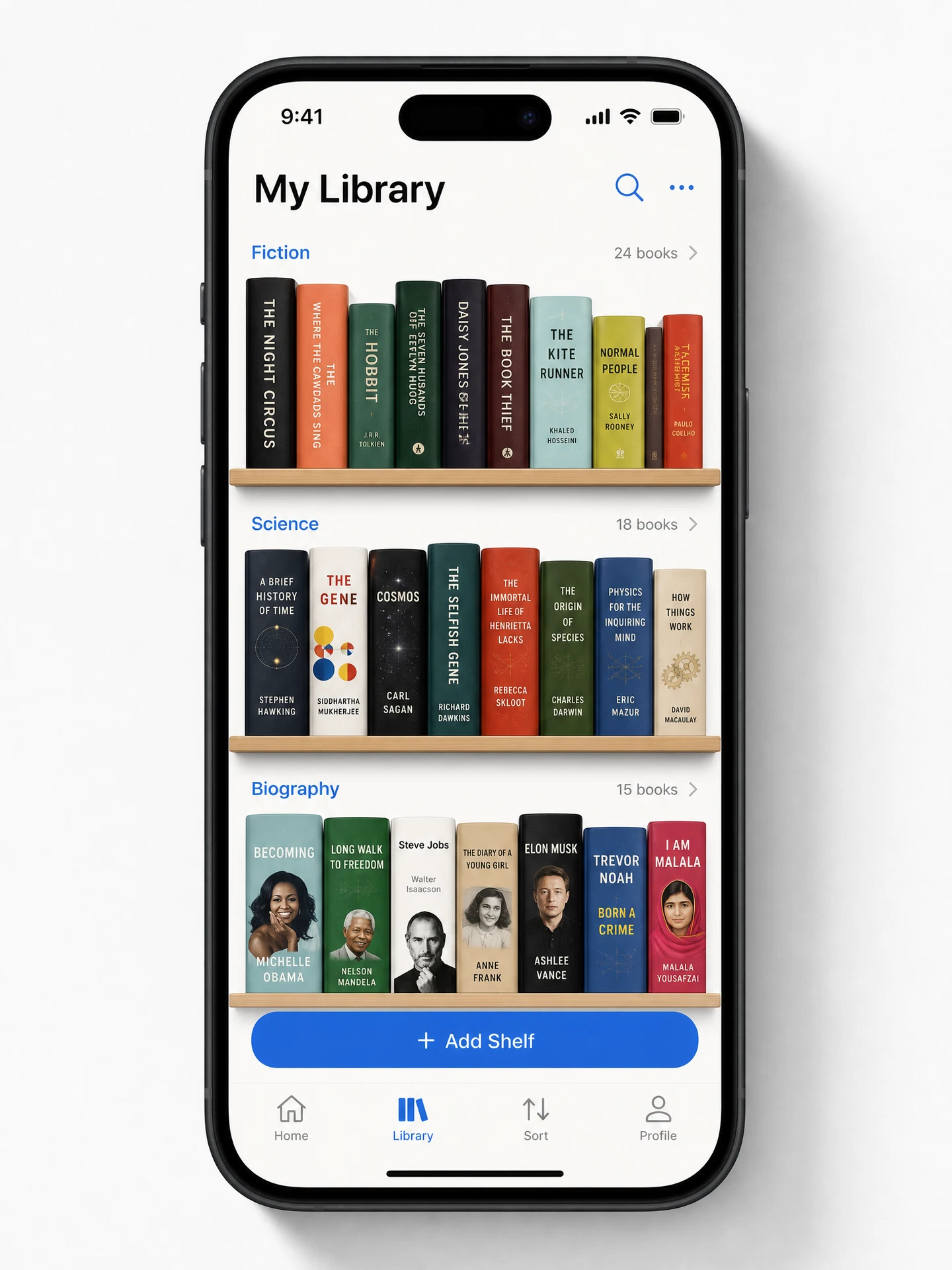
That used to be the deal-breaker for home collections, because typing five hundred titles into a spreadsheet is nobody's weekend. Scanning changed that: point your phone at each book's barcode and Better Bookshelf catalogs it in about a second — cover, author, genre, page count filled in automatically — or photograph a whole bookcase and let AI identify every spine at once, older books included. A few hundred books is one relaxed afternoon. Once the catalog exists, everything below gets dramatically easier — including the part where the app does the planning for you.
The shortcut
Photograph your shelves, then find any book on them
Every organizing system is a way of remembering where things are. A shelf photo does the remembering for you. Take one clear picture of each bookcase and Better Bookshelf identifies the books from their spines and saves each one's position. From then on, "where is it?" is a search, not a scan of every shelf in the house.
- One photo per bookcase: AI identifies the spines and marks where each book sits, with the books left in place
- Search a title or tap Find on shelf, and the shelf photo opens with that spine highlighted, a close-up, and the books beside it
- Name each shelf ("Study · North wall") so results read like directions, and rescan a shelf with a new photo when you rearrange
- Works with any arrangement — by genre, author, color, or none at all — because the catalog remembers the shelf, not the system
The five home library organizing systems (and who each one suits)
Every arrangement is a trade-off between findability, beauty, and upkeep. These are the five worth considering. With a searchable shelf photo behind them, you can weight beauty and upkeep a little more and findability a little less.
By genre, then author
The bookstore model. Fiction, history, science, cooking — each gets a zone, alphabetized by author inside it. Intuitive for browsing and guests can find things, but genre edges get fuzzy fast (is a food memoir cooking or biography?), and every new book means deciding all over again.
Strict alphabetical by author
One rule, zero ambiguity, and any book is findable in seconds — if you remember the author. Works brilliantly for fiction-heavy collections; less so when you think in topics rather than names.
Read / unread zones
Keep the books you haven't read where you'll see them, and the finished ones as the archive. Great for taming a to-be-read pile that's gotten out of hand; weaker as a lookup system, since a book moves shelves the day you finish it.
By subject, Dewey-style
A lightweight version of what real libraries do — number ranges or labeled zones by subject. The most scalable system for large nonfiction collections, and the most work to set up and maintain by hand.
By color or size
Beautiful on the shelf and on Instagram, and genuinely fine for a small display collection. Past a hundred books it turns every retrieval into a memory test — you need to remember what each spine looks like.
Book storage ideas when the shelves are full
Serious collections outgrow their shelving — that's not a failure, it's a milestone. A few moves that work: horizontal stacks as bookends to reclaim vertical space; a rotating front-facing display for the books you're excited about this season; closed cabinets or under-bed boxes for the archive you're keeping but not browsing; and the spare-room wall you've been eyeing, because floor-to-ceiling shelving is almost always cheaper than it looks.
Two cautions from every librarian: avoid double-stacking rows (the back row effectively stops existing) and avoid attics, basements, and garages for books you care about — heat and humidity are how collections die. And if part of your library goes into boxes, catalog first: a box labeled "Books 7" is a mystery, but a catalog that says which books are in storage means nothing is ever really lost. The same trick makes moving house with a big collection survivable — scan before you pack, and unpacking becomes reshelving from a list.
Four moves that keep a large collection organized for good
Shelving gets you organized once. These keep you organized — because the catalog does the remembering.
Tag beyond the shelf
Physical order can only express one system at a time. Tags express all the others: "signed", "loanable", "research — WWII", "cabin house". A book sits in one spot but lives in many lists.
Track what leaves the house
Big collections leak — books get borrowed and never come back. The lending tracker records who took what and when, so the shelf gap has a name attached.
Merge your formats
The paperback, the Kindle edition, and the Audible audiobook of the same title show as one book with format badges. Your shelf photo locates the physical copy; your catalog covers all three.
Let go of books with a clean conscience
Downsizing? Filter to the books you'll never reread, export the list to CSV, and donate the boxes — the catalog keeps the record (and your ratings and notes) even after the paper is gone.
Frequently asked questions
What's the best way to organize a home library?
The best system is the one that matches how you look for books: genre zones if you browse by topic, alphabetical by author if you think in names, read/unread zones if your priority is finally getting through the pile. The step most people skip is cataloging first. Photograph each bookcase into Better Bookshelf and you get a searchable record of what you own and where it sits, so the arrangement can be whatever you like and search still finds the book.
How do I keep track of hundreds of books?
Not with a spreadsheet — data entry is why those projects die. A whole-shelf photo catalogs a bookcase at once and records where each book sits, barcode scanning handles new arrivals in a second each, and search, tags, and filters do the remembering. Most collections of several hundred books are fully cataloged in an afternoon.
Should I use the Dewey Decimal System for my home library?
Usually it's more system than a home needs — Dewey shines when many strangers share one collection. At home, a simplified subject-zone arrangement gets you the same findability with far less upkeep, and a catalog app supplies the precision Dewey would have: a saved shelf photo with each book's position, instant search, and a record of every book.
What should I do with books I no longer want?
Catalog them before they leave. Scan the giveaways, tag them "donated", export a CSV for your records (useful for taxes on large donations), and then pass them to a library sale, Little Free Library, or used bookstore. You keep the memory of the book — your rating, your notes — without keeping the paper.
From book pile to home library
Photograph your shelves this afternoon and never lose a book in your own house again. Your first 50 books are free — no sign-up, no ads. Whole-shelf scanning comes with the one-time Unlimited upgrade.